Click HERE to return to all specific events.
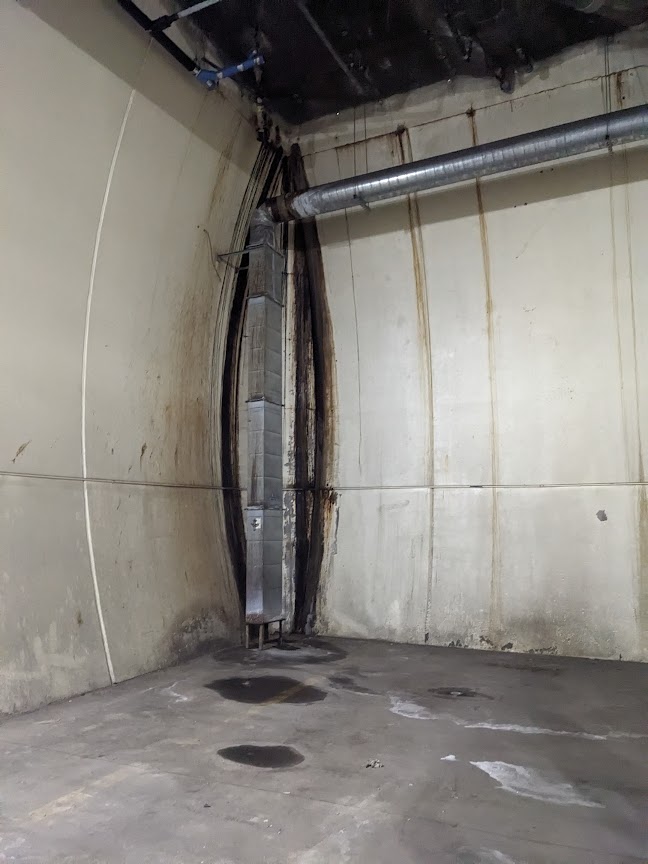
Photo of the contaminated groundwater seeping down in the corner of the caverns in the MLAC garage on the West Bank campus of UMN-TC. Image is original. April 2025.
The Minnesota Library Access Center (MLAC) site is a subsurface archival building on the University of Minnesota’s West Bank campus. The building was built into the St. Peter sandstone, below the Platteville limestone. Approximately 2.7 million cubic feet of the St. Peter sandstone was excavated in the late 1990s, with MLAC officially opening in 2000. MLAC is climate controlled and protected from flooding and groundwater leakage by a complex system of pumps and collection systems.
Beneath the MLAC site are several sedimentary units, including unconsolidated glacial till (10s of feet), a thin layer of Decorah shale (approx. 5 feet), and a thick layer (20-30 feet) of Platteville limestone, which includes the Magnolia, Hidden Falls, and Mifflin members, from top to bottom. A bed parallel parting (approx. 1 cm wide) between the Magnolia and Hidden Falls members facilitates the spread of groundwater horizontally throughout the area. Beneath the Platteville limestone is the Glenwood shale and St. Peter sandstone units. The Platteville limestone members contain horizontal and vertical fractures that facilitate the flow of a large magnitude of groundwater.
The MLAC construction site was built near the site of a historic gas refinery. This refinery had storage tanks that leaked contaminated water and tar into the groundwater for decades. When the St. Peter sandstone was being excavated, workers found severely contaminated water leaking down through the Platteville, which acted as the ceiling for the excavated space. In order to mitigate this contamination, preventing it from spreading further, a panning system and a large horizontal well was built under the Platteville to collect the dripping water and treat it.
Several monitoring wells are in place around the contamination plume, which are used to monitor the water level and the spread of the contamination through the groundwater system.
???